FDIR:以保真度為錨點的壓縮影像還原FDIR: Fidelity-Anchored Image Restoration
以單步 flow 先驗與殘差修正網路還原高度壓縮的影像,同時兼顧像素保真度、人眼感知品質與下游視覺任務。Restoring heavily compressed images with a one-step flow prior and a residual refinement network, balancing pixel fidelity, human perception and downstream vision tasks.
相關發表Publication : 頂尖電腦視覺國際會議審稿中Under review at a top computer vision conference
論文 FDIR: Fidelity-Anchored Decompressed Image Restoration for Human and Machine Perception 目前正於頂尖電腦視覺國際會議審稿中,預印本已公開於 arXiv。
問題
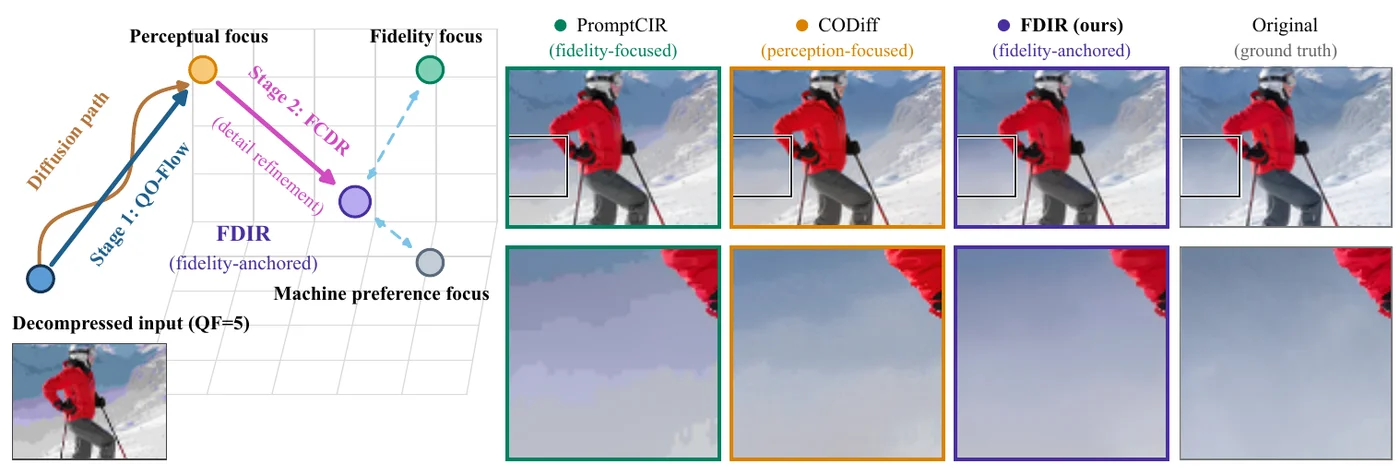
評估還原後的影像品質,需同時考量三個面向:像素是否忠於原圖(fidelity)、人眼視覺是否自然(perception),以及偵測、分割、檢索等下游視覺模型能否正確判讀(machine preference)。
現有的壓縮影像還原方法往往顧此失彼:回歸模型雖能維持高保真度,畫面卻容易過度平滑;生成模型能補出逼真紋理,卻容易偏離原圖。
方法
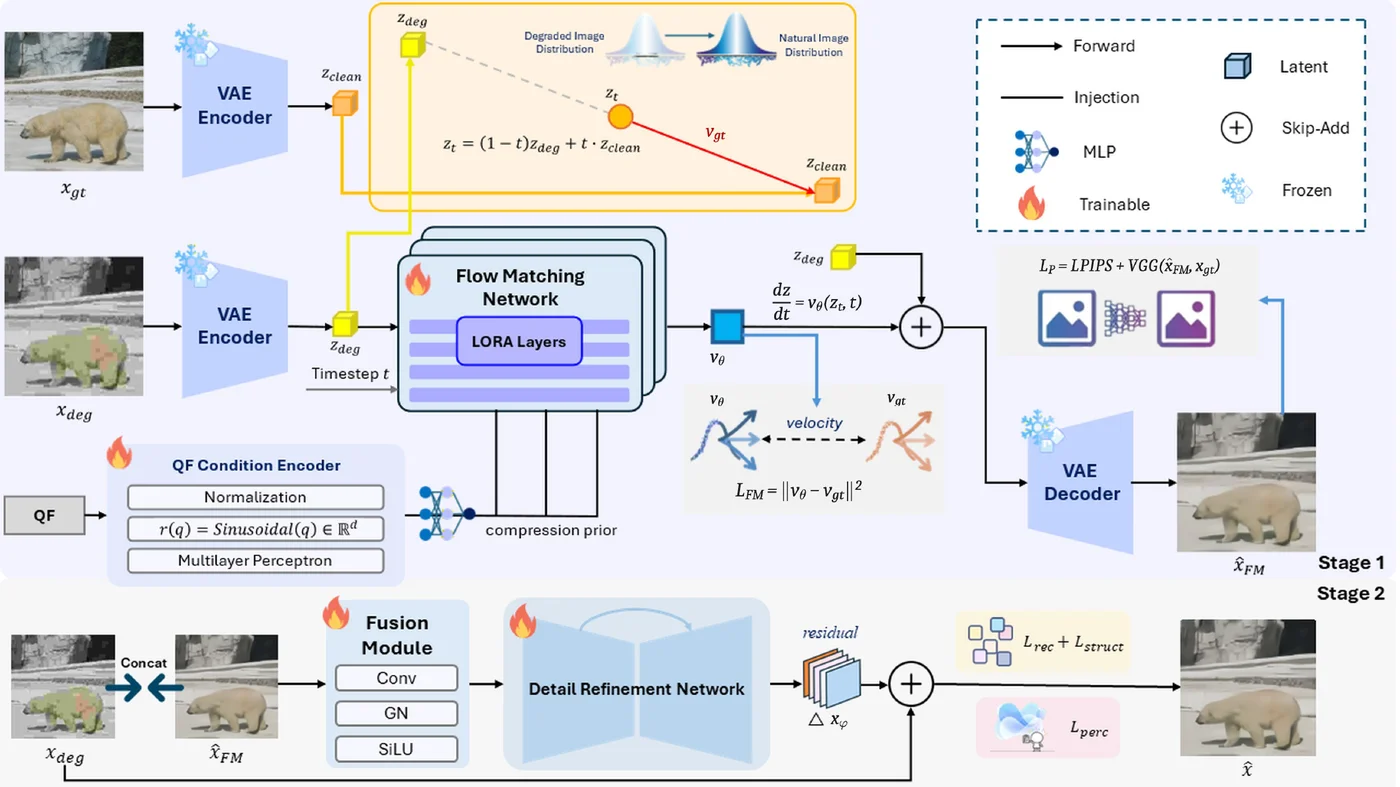
FDIR 分成兩個階段:
- 第一階段 QO-Flow(quality-guided one-step flow model):以 LoRA 微調預訓練的潛在空間 flow 模型,並將壓縮品質因子(QF)納入條件,僅需單次前向計算即可生成結構先驗。
- 第二階段 FCDR(flow-conditioned detail refinement network):不直接輸出生成影像,而是以該先驗為條件,在解壓縮輸入上預測像素空間的殘差。
最終輸出為「解壓縮輸入加上學到的修正」,因此稱為「以保真度為錨點」:先守住與原圖的一致性,再補上感知細節。訓練過程中僅更新 73.5M 參數,2.1B 參數的骨幹模型則維持凍結。
成果
- 嚴重壓縮(LIVE1、DIV2K,QF 1 與 5):在四種設定下,PSNR 皆位居 7 個比較方法之首,較最強的感知導向方法 CODiff 高出 1.3 至 2.1 dB;LPIPS 則在四種設定下均名列第二。
- 下游任務(QF 20 與 30):在偵測、分割與檢索共 10 項指標上全數排名第二,平均排名最佳。
- FDIR 是唯一在保真度、感知品質與機器偏好三項評估上,平均排名皆進入前兩名的方法。
我的角色
我為三位共同第一作者之一(equal contribution),本論文與臺大、成大、中研院等單位的研究者合作完成。
This work presents FDIR: Fidelity-Anchored Decompressed Image Restoration for Human and Machine Perception, currently under review at a top computer vision conference, with the preprint available on arXiv.
Problem
A restored image is evaluated across three dimensions: pixel faithfulness to the original (fidelity), natural visual appearance to humans (perception), and usability for downstream models such as detection, segmentation, and retrieval (machine preference).
Existing restoration methods for compressed images typically trade one off against the other: regression models preserve fidelity but appear over-smoothed, whereas generative models synthesize realistic textures at the cost of drifting from the original.
Approach
FDIR works in two stages:
- Stage 1, QO-Flow (quality-guided one-step flow model): fine-tunes a pretrained latent flow model with LoRA conditioned on the compression quality factor (QF), generating a structural prior in a single forward pass.
- Stage 2, FCDR (flow-conditioned detail refinement network): rather than directly outputting a generated image, it leverages the prior to predict a pixel-space residual on top of the decompressed input.
Because the final output equals the decompressed input plus a learned correction, the method is fidelity-anchored: consistency with the original comes first, with perceptual detail layered on top. Only 73.5M parameters are trained, while the 2.1B-parameter backbone remains frozen.
Results
- Severe compression (LIVE1 and DIV2K, QF 1 and 5): achieves the highest PSNR among the 7 compared methods across all four settings—1.3 to 2.1 dB above the strongest perceptual method, CODiff—and ranks second on LPIPS in all four settings.
- Downstream tasks (QF 20 and 30): ranks second across all 10 detection, segmentation, and retrieval metrics, achieving the best average rank.
- FDIR is the only compared method to place in the top two by average rank across all three axes: fidelity, perception, and machine preference.
My Role
I am one of three co-first authors (equal contribution), collaborating with researchers from NTU, NCKU, Academia Sinica, and partner institutions.